


It’s an eventful time for investors, with the stock market reacting to a range of economic factors. While many elements are at play, and I could write an op-ed about each of them (maybe I will over the next couple months). For this piece though, I’ll zero in on tariffs as they’ve been the main driver of the volatility over the last couple of weeks.
I think what’s clear is that this administration has a strong belief that tariffs are a tool to force change. “What changes are they after,” you ask? Well, let’s make an assumption that we can take the government at its word here (I can feel the eyes rolling from here).Here is an interviewI watched between Bloomberg and the US Secretary of Commerce Howard Lutnick. By the way, Mr. Lutnick is a guy who understands the market, to say the least. He was CEO of Cantor Fitzgerald before joining President Trump’s Cabinet. While sort of a lesser-known company due to it being privately held and not publicly traded, this is still a very large investment banking company. This video is worth a watch, but I’ll summarize below…
- Fentanyl: Interestingly enough, using tariffs to slow and stop the flow of Fentanyl into this country seems to be a major priority here. The government wants the flow of Fentanyl to simply stop flowing from China to Canada/Mexico and then into the US. The tariffs imposed this week on Mexico, Canada, and China are an attempt to solve this problem. It seems there are certainly negotiations along this front, and if those countries can prove they are making a serious effort to help solve this problem, then it seems there is room for the tariffs to be lifted.
- Reciprocity:The major tariffs haven’t even arrived yet, and they will be eligible to be imposed on April 2nd. These tariffs will attempt to solve the trade unfairness that exists between our country and many, many others. See this website pagefrom the White House for their examples.
- In classic mainstream media fashion, it seems impossible to find a balanced view on this issue. Clearly, there are countries that impose unfair tariffs/VAT on US goods coming into their countries. I wonder how it ever seemed fair that the EU charges a 10%+ tariff on US autos sold in their continent and the US only imposes a 2.5% tariff on European cars sold in our country. I, for one, would love to see both countries charge zero tariffs, but until that happens, equal seems fair to me.
- Good luck to Mexico and Canada on this issue. Goods from the US account for 62.2% of Canada’s imports and 75.9% of their exports. That won’t be a number that is easy for any country to solve, especially one with citizens already struggling with high prices and a lower standard of living. They can try to find a new trading partner, but my guess is that it won’t have the positive effect that they pretend it will, and it will take a lot longer than they’d like.
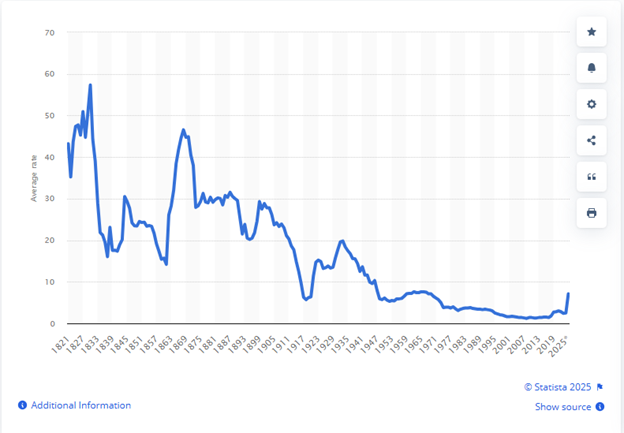
- Tariffs are not new. We’ve pretty much always had them, and in fact, they are way lower now than they used to be. Here’s a chart showing the average tariff rate the US has imposed since the year 1821. There are a lot of good years of economic growth in many of those years, so if I hear the word “tariff”, I don’t immediately think economic ruin, and neither should you.
- Let me be clear: I do not like tariffs, nor do I think they are the best way for economic growth, but I also don’t like the idea of the US being the victim of unfair trade with our so called “partners” and the Fentanyl problem is improved along this road as well. As far as how this all impacts the stock market, a few thoughts come to mind…
- What might be good in the long term might be painful in the short term.
- When negotiating, the end result will likely be somewhere in the middle of the two extremes.
- Good companies find a way to operate in any environment. We’ve seen this movie before, given the fact that President Trump has been president before and imposed tariffs during that term as well. I credit corporate America and Capitalism much more than the president, but here'show the stock market performed under President Donald Trump.
- What might be good in the long term might be painful in the short term.
- In classic mainstream media fashion, it seems impossible to find a balanced view on this issue. Clearly, there are countries that impose unfair tariffs/VAT on US goods coming into their countries. I wonder how it ever seemed fair that the EU charges a 10%+ tariff on US autos sold in their continent and the US only imposes a 2.5% tariff on European cars sold in our country. I, for one, would love to see both countries charge zero tariffs, but until that happens, equal seems fair to me.
*The information being provided is strictly as a courtesy. When you link to any of the web sites mentioned, we make no representation as to the completeness or accuracy of information provided at these web sites. The opinions found therein are those of the author(s) of the article or website.
The opinions voiced in this material are for general information only and are not intended to provide specific advice or recommendations for any individual. All performance referenced is historical and is no guarantee of future results. All indices are unmanaged and may not be invested into directly.


